|
Inquiry-Based Teaching Methods
How Can Inquiry-Based Teaching Be Implemented? Teachers play a vital role in adapting the inquiry process to the knowledge and ability level of their students. When using inquiry-based lessons, teachers are responsible for
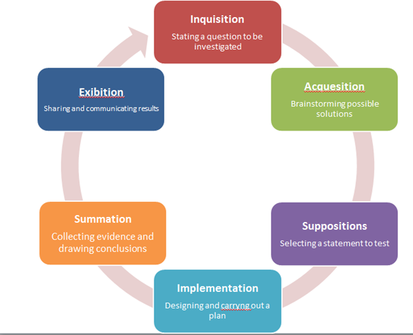
When incorporating inquiry-based methods into the classroom, educators should ensure that each of the six stages of the inquiry cycle, as shown below, is complete. |
What inquiry is not?
1. Inquiry is NOT the same as hands-on
Taking students to the lab, does not mean the lab is inquiry; not if the lab is solely to reinforce a concept they've learned by reading text. This is not say that these hands-on experiences are not important-they are. But let's be clear; not all hands-on labs, or demos for that matter, make students think for themselves. Similarly, using manipulatives is great, it helps students understand complex scientific processes, but often students are not using them in an inquiry way. Instead, manipulatives help them learn conceptual facts that they will be asked to share again in some form of assessment (objective test, essay, or oral quiz). Manipulatives CAN be used in inquiry ways, but it takes students longer to get the idea, and most teachers don't spare the time.
2. Post-Lab Questions or Lab Reports are NOT (usually) Inquiry.
Having students write answers to post-lab questions or write lab reports in order explain the knowledge the laboratory experiment helped them understand is not inquiry. Written assignments that students turn in after completing a hands-on activity or lab, usually make sure the correct answer was achieved, that students knew why they got the results they did, and maybe an additional question that may require them to put the experiment in context of why the experiment matters or applies in real life.
3. Students do NOT need background information before they can begin learning.
I spent a lot of time getting my students "ready" for lab. They learned lab skills and more importantly, they learned the content so that they would be able to understand the experiment or laboratory experience to the fullest. And I believe I did my students a dis-service teaching all my labs this way. And I kinda knew this at the time, because the best teaching experiences I had were in content areas with which was less familiar (physics), and therefore, didn't have the background knowledge myself to get them ready! For example, I knew very little about simple machines, but we did a mouse trap car lab. I couldn't (or chose not to) give them any background before we started. Students knew they were to get the mouse trap to propel the car forward, so they worked together (trial and error) until they got it to work. That is inquiry. Students don't have to have the scientific vocabulary before they begin a lab. They only need to be curious, and that is the motivation.
About inquiry learning we learned from different sources. Some of them, we find on interent:
Taking students to the lab, does not mean the lab is inquiry; not if the lab is solely to reinforce a concept they've learned by reading text. This is not say that these hands-on experiences are not important-they are. But let's be clear; not all hands-on labs, or demos for that matter, make students think for themselves. Similarly, using manipulatives is great, it helps students understand complex scientific processes, but often students are not using them in an inquiry way. Instead, manipulatives help them learn conceptual facts that they will be asked to share again in some form of assessment (objective test, essay, or oral quiz). Manipulatives CAN be used in inquiry ways, but it takes students longer to get the idea, and most teachers don't spare the time.
2. Post-Lab Questions or Lab Reports are NOT (usually) Inquiry.
Having students write answers to post-lab questions or write lab reports in order explain the knowledge the laboratory experiment helped them understand is not inquiry. Written assignments that students turn in after completing a hands-on activity or lab, usually make sure the correct answer was achieved, that students knew why they got the results they did, and maybe an additional question that may require them to put the experiment in context of why the experiment matters or applies in real life.
3. Students do NOT need background information before they can begin learning.
I spent a lot of time getting my students "ready" for lab. They learned lab skills and more importantly, they learned the content so that they would be able to understand the experiment or laboratory experience to the fullest. And I believe I did my students a dis-service teaching all my labs this way. And I kinda knew this at the time, because the best teaching experiences I had were in content areas with which was less familiar (physics), and therefore, didn't have the background knowledge myself to get them ready! For example, I knew very little about simple machines, but we did a mouse trap car lab. I couldn't (or chose not to) give them any background before we started. Students knew they were to get the mouse trap to propel the car forward, so they worked together (trial and error) until they got it to work. That is inquiry. Students don't have to have the scientific vocabulary before they begin a lab. They only need to be curious, and that is the motivation.
About inquiry learning we learned from different sources. Some of them, we find on interent:
|
|
|
|
|
|
